Transparency Note: This post contains affiliate links. As an Amazon Associate, we earn a commission from qualifying purchases at no extra cost to you. The design concepts featured in this post were created with AI to provide decor inspiration for your home.
The Quiet Power of the Japandi Kitchen
The kitchen is often the loudest room in the house, both literally and visually. To combat the chaos of modern living, we are deconstructing the anatomy of a Japandi kitchen—a design movement that prioritizes intentionality over ornamentation. From the seamless integration of a honed stone island to the airy freedom of a single floating shelf, we explore how to edit your space for maximum performance and minimal stress.
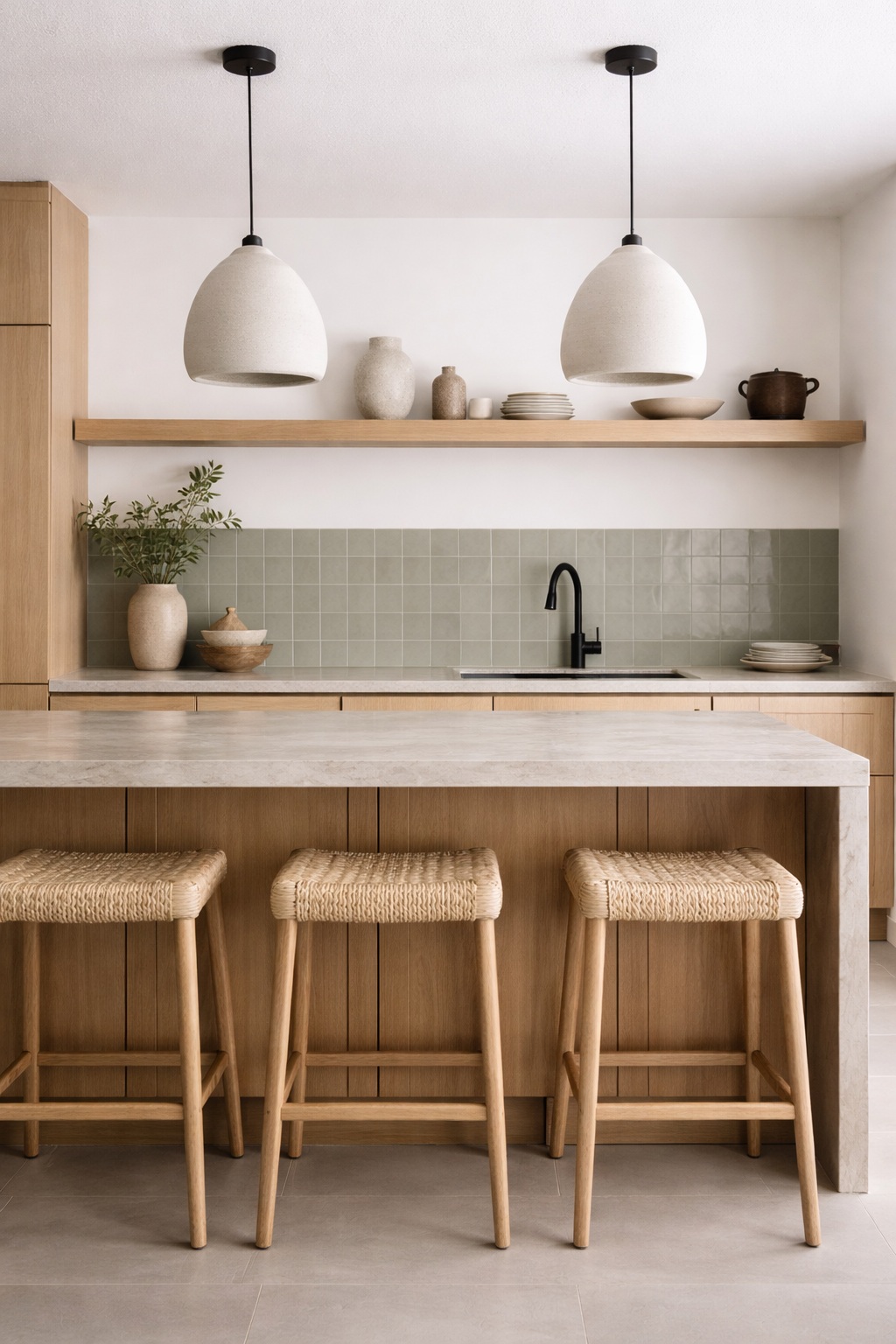
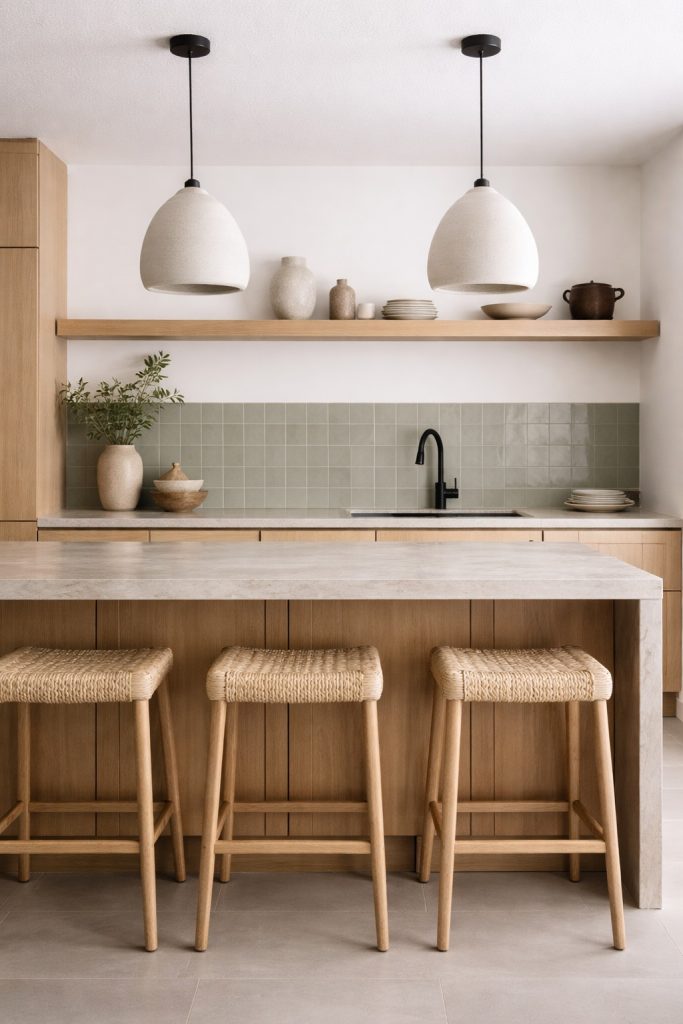
This space exemplifies the “Japandi” spirit—a sophisticated blend of Scandi-Neutral Minimalism and organic Japanese textures. Discover the 7 essentials that transform a functional cooking area into a modern restorative sanctuary.
7 Design Essentials for the Japandi Kitchen
Essential #1:Honed Stone Surfaces
The choice of a matte, honed finish over a high-gloss polish is essential for achieving Tactile Grounding. In this kitchen, the thick waterfall island acts as a central anchor, providing a cool, velvety texture that feels permanent and serene. By avoiding reflective surfaces, you eliminate “visual noise,” allowing the natural veining of the stone to become a quiet, sophisticated focal point.
Essential #2: Muted Sage Backsplash
The backsplash serves as the “Sage” in our Sage & Honey palette, using small-scale square tiles to introduce a rhythmic, organic texture. This specific shade of green acts as a bridge between the crisp white of the walls and the warmth of the wood, creating a Biophilic connection that lowers the heart rate. When caught by the light, the subtle variations in the tile glaze are amplified, creating a soft shimmer that adds a handcrafted Japanese “Wabi-Sabi” feel. This prevents the kitchen from feeling static or industrial, ensuring the “Visual Quiet” is layered with depth.
Essential#3: Honey-Toned Oak Cabinetry
To maintain the Scandi-Neutral base, the lower cabinetry utilizes flat-panel light oak with a vertical grain. This choice maximizes organic symmetry, drawing the eye across the room in a clean, uninterrupted line. By using integrated finger pulls instead of traditional handles, we remove another layer of visual clutter, ensuring the cabinetry feels like a custom architectural feature rather than just storage.
Essential #4: The Art of the Single Shelf
Removing upper cabinets is perhaps the most effective way to achieve Visual Quiet in a kitchen. A single, thick floating shelf made of the same honey oak as the cabinets creates an “airy” horizon line that opens up the entire room. This is a space for peaceful harmony: it challenges you to display only your most cherished, high-quality ceramics, turning daily-use items into a curated gallery of functional art.
Essential #5: Ceramic Pendant Lighting
In a space defined by clean lines, lighting should act as functional sculpture. These oversized, bell-shaped ceramic pendants introduce architectural weight without the “coldness” of metal or glass. Their matte, stoneware finish diffuses light softly, contributing to the restorative atmosphere while anchoring the island within the larger room. By choosing a material that feels like an extension of the curated pottery on your shelves, you create a cohesive, handcrafted narrative throughout the kitchen.
Essential #6: Hand-Woven Natural Seating
To prevent a minimalist kitchen from feeling sterile, you must introduce a layer of “human” texture. These bar stools, featuring natural paper cord or seagrass weaving, provide a rustic, Japanese-inspired contrast to the precise geometry of the island. This element of Tactile Grounding ensures the space feels approachable and lived-in, honoring the Japandi principle of finding beauty in natural, organic materials.
Essential #7: Matte Black Anchors
While the Sage & Honey palette provides the warmth, matte black accents provide the “visual ink” that defines the space. The high-arc faucet and slim pendant cords act as sophisticated punctuation marks against the lighter wood and stone. These anchors provide the necessary contrast to lead the eye through the room, ensuring the Scandi-Neutral tones feel intentional and high-end rather than washed out.
Curated Essentials: Shop the Look
A Culinary Haven is built one intentional piece at a time. We have selected a collection of elements that embody the Japanese “Wabi-Sabi” spirit and the airy serenity of Japandi design. Use the links below to discover the building blocks of this restorative kitchen—curated to ensure your space remains a sanctuary of peaceful harmony and Visual Quiet.
Note: The search result links below are affiliate links.
Furniture
- Kitchen Island – https://amzn.to/4rNrRUj
- Sink Base Cabinet – https://amzn.to/4kLHIAI
- Base Cabinet – https://amzn.to/4akTz5a
- Kitchen Storage Cabinet – https://amzn.to/40chBcw
- Floating Shelf – https://amzn.to/4rtU5Ur
- Bar Stools – https://amzn.to/4awH70W
Lighting
- Ceramic Pendant – https://amzn.to/3OKwj80
Decor
- Backsplash Tiles – https://amzn.to/3ZDK6zM
- Floor Tiles – https://amzn.to/465ZGI6
- Peel and Stick Countertop Paper – https://amzn.to/4bSjlyM
- High-Arc Faucet – https://amzn.to/463BYw4
- Black Sink – https://amzn.to/4aAuYIe
- Ceramic Vases – https://amzn.to/4qCHrRG
- Artificial Branches – https://amzn.to/3OkSQbu
- Ceramic Tableware – https://amzn.to/4aRL3uv
- Ceramic Pot – https://amzn.to/46UfBcD
Creating Your Own Culinary Haven
Architecting a kitchen that embodies Scandi-Neutral Minimalism is about more than just choosing the right materials; it is about cultivating a space that actively supports your well-being. At the same time, the beauty of the Japandi aesthetic lies in its effortless balance: the warmth of the “Honey” oak meeting the cool, rhythmic texture of the “Sage” tile. By embracing the handcrafted Japanese “Wabi-Sabi” feel and grounding it with modern architectural anchors, you create a kitchen that is both timeless and deeply healing.
Whether you start with the tactile grounding of a honed stone surface or the visual quiet of a single floating shelf, remember that the most successful edits are those that bring peaceful harmony to your everyday rituals.